THE QuintessenCE
– because you live with your body for a lifetime
A full-body deep muscle training developed by Benita Cantieni. Through targeted exercises and breathing techniques, the body’s bones are realigned into their optimal positions, aiding in pain relief and joint wear prevention. The focus is on strengthening the deep pelvic floor, the levator ani, and the diaphragm as an intermediate level. By creating space in the joints, stretching and strengthening muscles, and elongating the spine, individuals achieve greater mobility, responsiveness (crucial for preventing falls and accidents), strength, and grace. An upright and elongated posture enhances one’s presence – for a lifetime. These exercises foster a harmonious connection with the body, leading to a new bodily happiness that positively influences mental well-being. Due to the subtlety of the exercises, which can be individually adjusted in difficulty, this training is suitable even into advanced age.
FROM SOLE TO CROWN
Through precise guidance, deep muscle groups and fascia are engaged, especially the levator ani (the innermost layer of the three pelvic floor layers), the autochthonous back muscles with the longitudinal spinal ligaments, and the diaphragm. The method is based on the principle of tension and counter-tension, aiming to optimally elongate the body and create space in the joints: the pubic bone and coccyx stretch in one direction, the crown point in the opposite. This elongation interconnects the musculature, establishing a foundational tone that fosters energy, alertness, responsiveness, and radiance
THE VARIOUS ELEMENTS
Pelvis
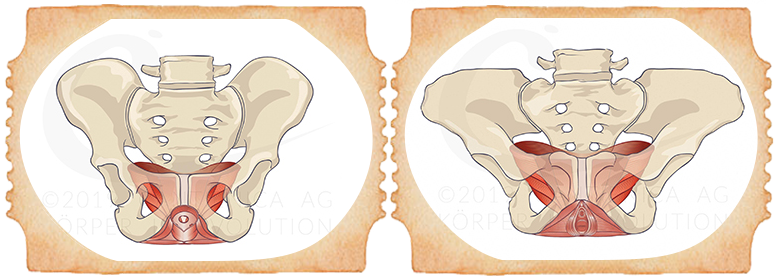
The foundation of the upright body, consisting of pelvic blades and hip bones, sacrum, ischial tuberosities, pubic bone with pubic symphysis, and coccyx.
In the Cantienica method, aligning and elongating the pelvis is central, as its position influences the posture of the entire body. Even slight shifts alter the alignment of the vertebrae and the position of the rib cage.
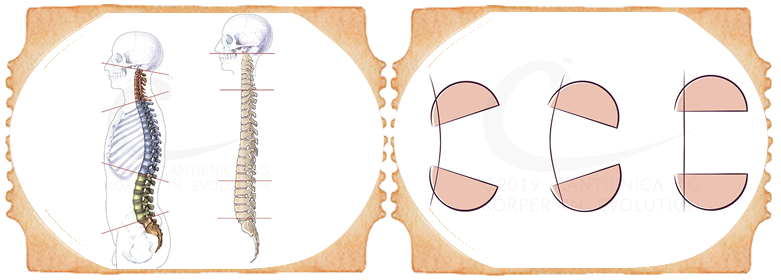
The interplay of muscles and ligaments in the pelvis, aligning the pelvic blades, sacrum, pubic, and coccyx bones, directly affects the joints of the feet, knees, ankles, hips, sacrum, shoulders, spine, and head.
Pelvic Floor Musculature
The pelvis is supported by three layers of pelvic floor muscles:
The outermost layer comprises the so-called sphincter and erectile muscles.
The middle layer extends from the pubic rim to the tips of the ischial tuberosities, forming the front wall of the pelvis.
The innermost layer stretches from the sacrum over the lateral pelvic bone edges to the pubic bone. The levator ani is part of this layer, cradling the pelvic organs like a bowl.
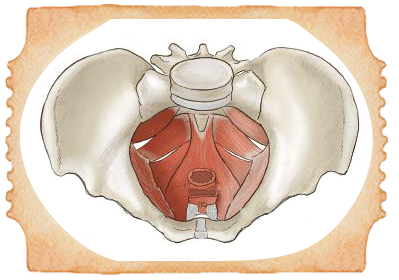
- Musculi Puorectalis, Puboccocygeus, Coccygeus, Iliococcygeus (Levator Ani), Obturatoris intern, Musculus Pyramidalis, etc
The Hip Musculature
The hip muscles are connected via ligaments and tendons to the pelvic and pelvic floor muscles, protecting and supporting the sacroiliac and hip joints.
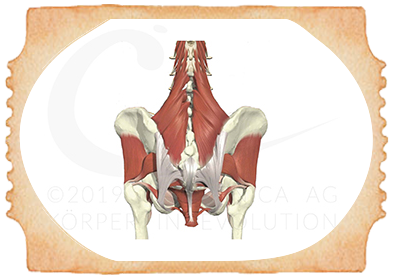
- Musculi Gluteus minimus, Piriformis, Gemellus superior, Obturator interns, Gemellus inferior, Quadratus femoris, Psoas major, Psoas minor, Iliopsoas
Spine
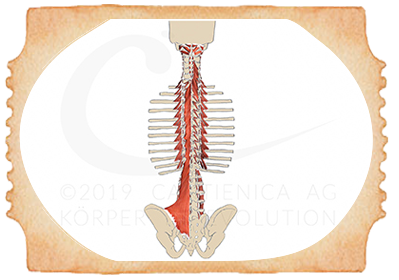
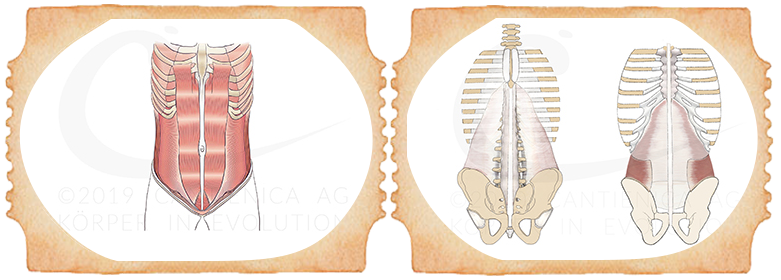
The spine is protected and supported by the autochthonous back muscles (over 200 small muscles surrounding each vertebra). Longitudinal ligaments run along the front, back, and sides. Through the multifidus, a multi-segmented muscle, and the iliocostalis, the inner pelvic floor layer is interconnected with the autochthonous back muscles.
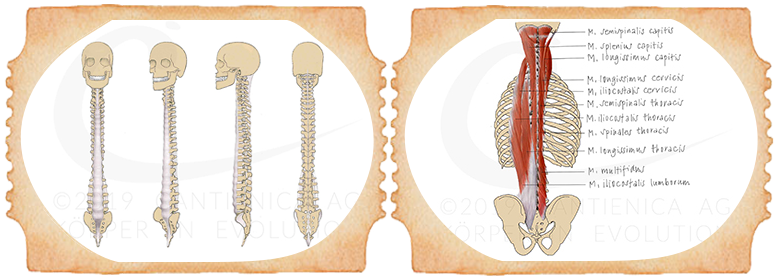
Thorax and Diaphragm
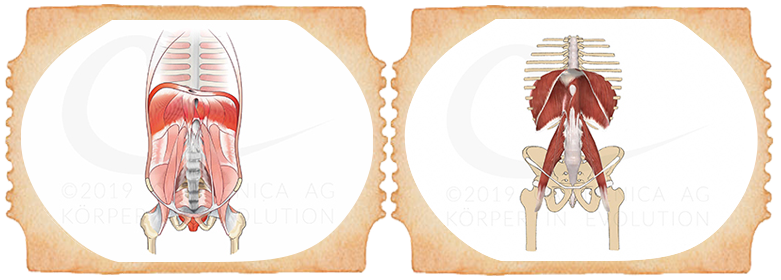
In optimal elongation, the rib cage aligns precisely above the pelvis. The sternum extends lengthwise. The abdominal longitudinal ligaments stretch the rib cage away from the pelvis. The diaphragm is established as an „intermediate level“ in the body, protecting the organs beneath. Thus, during breathing, the diaphragm doesn’t press downward into the abdominal cavity but expands radially to the sides like a paraglider.
Neck and Head
With an upright and elongated torso, the head can almost weightlessly sit atop the upper cervical vertebrae. Seven layers of neck muscles support the head. Through the tension and counter-tension principle between the coccyx and crown point, the head is brought into its optimal position. The chin is at a right angle to the neck, and the tongue root rests elongated against the palate. The joints between the axis, atlas, and skull are free and can move in all directions.
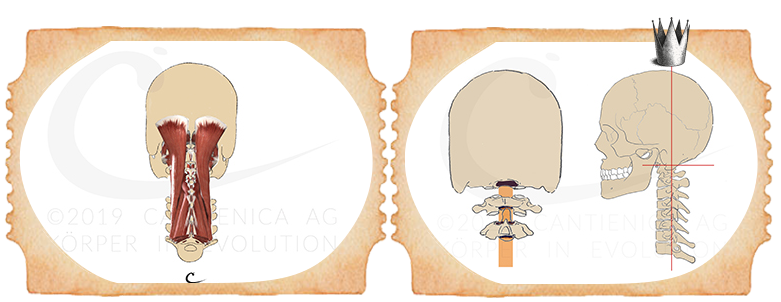
- deep neck muscles : Musculi Longus capties, Longus colli, Interspinalis cervicis
- scull supporting muscles : Musculi Rectus wapitis posterior, Obliquus capitis posterior, Semispinalis wapitis, etc.
Shoulders and Arms
Clavicle, scapula, and humerus. While the legs, pelvis, spine, and head focus on elongation, the arms, due to their own weight, can relax and detach from the shoulder joint socket and the acromion. The clavicles are horizontal, and the shoulder blades lie smoothly against the back.
When the arms hang relaxed, many forearm muscles rotate inward, while the upper arm muscles rotate outward, stretching the chest muscles.
Leg axis
The main muscles of the lower leg rotate inward, while the main muscles of the thigh rotate outward, with the leg bones remaining nearly aligned along the central axis. The position of the feet and the alignment of the pelvis help the body orient itself along its midline. This relieves pressure on the ankle and knee joints and creates space in the hip joints. The groins can open.
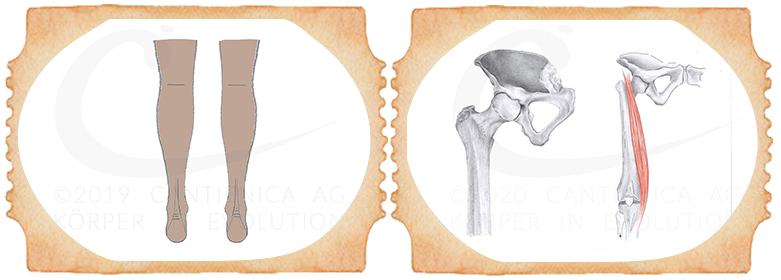
- Musculus Tibialis anterior, Musculus Sartorius
Feet
According to the Cantienica® Method, the feet are in their optimal position when the heels are slightly closer together than the toes, i.e., aligned in a subtle V-position. The weight is distributed between the center of the heel and the base joint of the big toe. In this way, the bony pelvis also assumes a V-position, allowing the deep muscles from the feet to the skull to interconnect optimally.
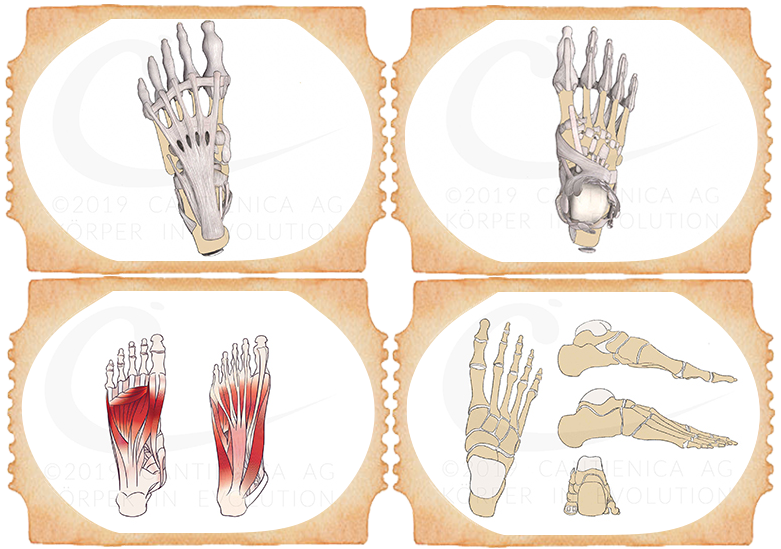
The longitudinal muscles of the toes are directly or indirectly connected to the leg, hip, and pelvic muscles via the Achilles tendon and the hamstring tendon. Their activation thus affects the inner pelvic floor. This only happens when the feet are in a V-position!
- Musculi Aductor hallucis, Caput transversum, Flexor hallucis, Flexor digitorum longus, Musculi Abductur digiti minimi, etc.
Problems that may be associated with a weak pelvic floor
- Postural misalignments and their consequences
- Muscle tension
- Incontinence (bladder, bowel)
- Headaches, migraines, tinnitus
- Hollow back, rounded back
- Pelvic tilt, bow legs, knock knees
- Organ prolapse, pelvic floor muscle laxit
- Hemorrhoidal issues
- Prostate enlargement
- Erectile dysfunction
- Foot deformities, hallux valgus, heel spurs, splayfoot
- Osteoarthritis, joint complaints
- Trigeminal neuralgia
- Scoliosis
- Herniated discs
- Generalized anxiety and depressive moods
For more information, visit cantienica.com